Memory, forgetting, and record-keeping
The SilenceMemory, forgetting, and record-keeping become ways for the characters to test what remains knowable when familiar systems fail. In the aftermath of a crash and amid an uncertain collapse, recollection is neither a dependable archive nor a purely private possession: it falters, returns late, and is sustained by other people and by written traces. A blue notebook, a remembered name, a wound noticed by someone else, and the crossed-out marks in a manuscript each preserve a different kind of evidence.
Memory Under Pressure
On the flight, a man begins reciting changing details aloud because merely noting them in his mind means losing them at once in the combined drone of thought and aircraft. He names the altitude as thirty-three thousand and two feet and the outside temperature as minus fifty-eight degrees Celsius. The figures are exact, but their recitation is also an attempt to hold experience in place: speech gives the details a momentary form while the surrounding noise threatens to dissolve them. Beside him, a woman continues writing in a little blue notebook, making a parallel record rather than relying on recollection alone.
That exchange makes remembering a shared, improvised practice. The man waits for the woman to correct his use of the temperature scale, but she is absorbed in the notebook and takes time before continuing to write. Their attention does not synchronize perfectly. The scene presents record-making not as a seamless safeguard but as a fragile activity carried out amid distraction, with speech and handwriting preserving different parts of a passing moment.
A missing fact can also return without technological help. During the conversation, Tessa Berens suddenly remembers Anders Celsius; Jim Kripps supplies the surname, and the name becomes a small recovery shared between them. The narration stresses the satisfaction of retrieving something from what had seemed like nowhere. The recovered name is not simply information: its emergence makes visible how much knowledge feels lost until another mind, a pause, or an association brings it back. In a world where digital assistance can no longer be assumed, that ordinary act of recall acquires unusual weight.
Notebooks and the Future Reader
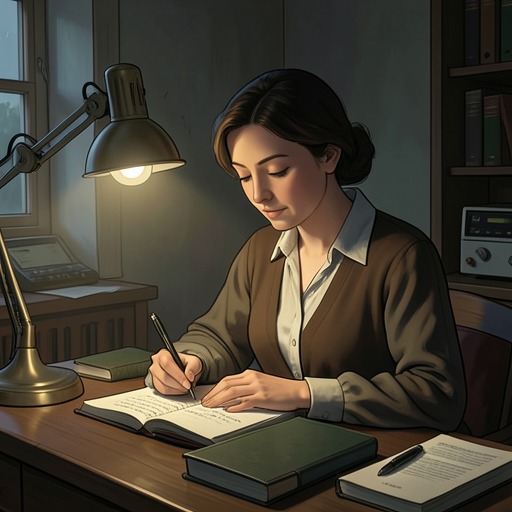
Tessa’s writing practice extends far beyond the flight. She describes keeping little notebooks for years, filling them with ideas, memories, words, possible lines of poetry, and even observations of supermarket packaging. She revisits older notebooks and is surprised by what she once thought worth recording. Reading them carries her back into what she calls dead time: the past returns through the written marks, though the earlier self who made them cannot be fully recovered.
The notebook is deliberately modest and portable. Tessa describes the little blue volumes as roughly three by four inches, small enough to slip into a jacket pocket, and says that dozens still wait unused at home. When she travels, she takes two or three and writes down what she sees and hears. The practice turns attention into a record, but she does not claim that the record has public authority. She regards the journal as meaningful to her alone, an accumulating store of observations whose value may become apparent only when she reads them again.
Writing also preserves the possibility that a future self will find something missing from present understanding. Tessa wants to see her own handwriting perhaps twenty years later, if she is still alive, and discover an element she cannot see now. The thought remains conditional: both the survival of the writer and the future circumstances of the reader are uncertain. Her notebooks therefore promise neither complete memory nor guaranteed continuity. They give a later self a material trace to consult, while leaving open what that self will be able to recognize in it.
The Limits of Recall
The novel sets that deliberate record against everyday forgetting. Diane Lucas observes that people can often recount the details of a restaurant meal from a week earlier, yet fail to remember what they ate on an airplane, whether the meal was served in first class, business class, or economy. Tessa can name the spinach-and-cheese tortellini from her flight, briefly interrupting the pattern Diane describes. The contrast suggests that memory does not preserve experience according to a simple measure of importance: an ordinary detail may disappear, while a particular meal remains available to one person and not to others.
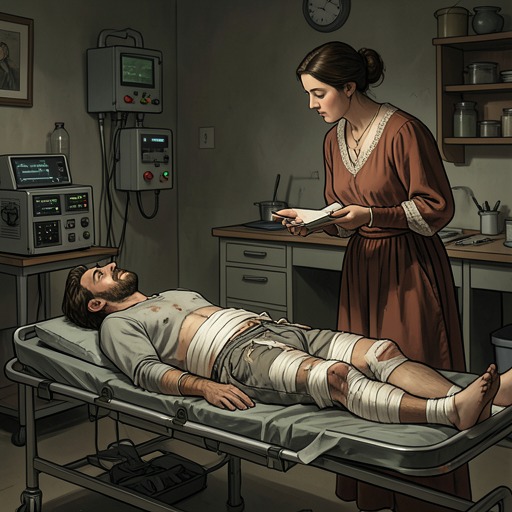
Forgetting is also bodily and immediate. Jim asks why he and Tessa are standing there, and she reminds him that he has a wound on his head. He has forgotten both the injury and how he got it; Tessa recalls the gash, the moment the passengers undid their seatbelts and hurried to escape after the crash landing, and his head striking the window. His body carries evidence that his conscious account has lost. Memory in this moment is interpersonal: Tessa supplies the missing sequence, and her observation links a visible wound to an event Jim cannot summon on his own.
Recollection After the Crash
Jim’s later account of the landing arrives as a belated effort to think through what happened. He recalls waiting for a snack before landing, the plane jolting and making loud bangs, and looking out at nothing while waiting for reassurance from the pilot. He remembers Tessa seated beside him, the unreassuring voices over the intercom, and the sense that other passengers had faced this same beginning before being silenced. Yet as he speaks, he questions whether some of those thoughts occurred at the time or have been assembled in the present. He says the events seem a dozen years distant even though they took place only hours earlier.
The memory breaks and doubles back over specific details: the pilot speaking French, the seatbelts, the missing snack, someone shouting about fire, the impact, and blood running into Jim’s eye. He reaches for Tessa’s hand and remembers her looking at the blood on his face. Even the question of whether she translated the French announcements remains uncertain to him. The account preserves the crash’s sequence while displaying the instability of its reconstruction; Jim can name the sounds, actions, and physical sensations, but cannot always distinguish immediate perception from later interpretation.
He identifies this telling as his first real chance to think about and remember the crash. Before it, there had been the van, the clinic, a woman talking, a man in a baseball cap bandaging his head, and then the street. That compressed sequence marks how practical demands and injury delayed reflection. The narration gives the event room to return only after those intervening experiences, so that remembering becomes an act performed in the present rather than a record made at the time.
Records, Traces, and Shared Knowledge
A different kind of record appears in the discussion of Einstein’s 1912 Manuscript on the Special Theory of Relativity. Its crossed-out words and phrases let viewers see thought in revision; the handwritten numbers, letters, and expressions matter alongside the theory they help compose. The manuscript is not merely a container for finished knowledge. Its visible alterations preserve traces of work—the movement from one formulation toward another—that a clean final text would conceal.
Across these examples, remembering depends on more than individual mental capacity. Jim’s spoken figures, Tessa’s notebooks, her account of his wound, the remembered airplane meal, and the manuscript’s revisions are unlike one another, but each makes experience available beyond the instant in which it occurred. Their limits remain equally important: notebooks can contain trivial or crossed-out observations, people forget what seems obvious, and a vivid recollection may incorporate uncertainty about what was actually thought or heard. The novel’s record-keeping is thus neither a cure for forgetting nor a guarantee of truth. It is a way to leave traces that another person, or a later version of the self, may use to recover part of what would otherwise vanish.